A friend recently challenged me to give up the journo-style of writing I've used writing this blog and the last one. Part of the reason I used that style is because I can generate a lot of it really easily. (Just being honest.) More importantly I used it because I wanted to write about what I thought about things that were happening in the world instead of talking about what's happening with me.
Usually things that are happening with me fall into two categories. Either they're stuff that is too personal to talk about (I have about three of those things right now) or they're things which aren't really that interesting. I think that makes sense and is probably the case with most people. So even when I do talk about my own life, it's because I participate in it. I present it like a reporter who wanted to make sure all of the facts were right over talking about the experience of being there.
So I'm using this post as a declaration of dropping the journo-style and with it the detached subject matter. If you want to know what I thought of the Broken Social Scene show last night or the Presidential election, you'll have to ask me directly. I'm going to migrate into a different style for a while and see what's over there. This will no longer be a blog of ideas. It will be a blog of Mike Herman.
Wednesday, October 15, 2008


Tuesday, October 7, 2008
Thoughts Before A Debate
The general consensus this election cycle is the Obama campaign needs to be careful about not being a bully, especially towards Sarah Palin. Let's set aside general politicking for a minute. I find it more interesting that bullying is considered the natural order of the Obama campaign if not politics in general.

It's odd to me because what one side perceives as bullying is often just criticism by the other side. Since the two-party system works best when the two sides are collaborating (because then it really is the will of the people and not just the ruling party), the necessary first step is to collect the consensus of the other party. Part of this consensus-building is defining and then mediating the differences between your viewpoint and that of your collaborator.
What has changed in America in the last 15 years is things have gotten really tight, really negative and really focused on winning. There is so much at stake in each race because of the former that candidates are willing to do the middle to because they are the latter. More and more candidates are doing it and will continue to do it because it works. People respond to clear, simplified black and white more enthusiastically than muddled greys.
Which flies completely in the face of the necessary first step of collaboration and actually harms American politics. Everything is so amped up and focused on ripping out the other guy's jugular what's lost that governance is really supposed to be about moving the whole country together into prosperity. That comes with making some sacrifices especially in the "always needing to be right" arena.
You need to slow things down, think about the three fingers pointing back when you point one away and use your reasoning to criticise yourself. If you were going to fight to the death, would this be the issue? Is this really something that you really want to be your legacy, the thing people think of when they think of you?

Each of the candidates for President this year are promising change. Obama has been known as a man who focuses on change since he gave the keynote address at the Democratic convention four years ago and John McCain's allure to voters on both sides of the aisle since 2000 springs from his deserved reputation as a bipartisan worker. I hope whomever wins in November stays true to his roots and he knows the way to really create change is through grace.
Our country has endured bullying as the modis operandi of politics for too long, almost a whole generation. It's time to begin collaborating again, not berating the other side into deep-held anger. The necessary first step in collaboration is to collect the consensus of the other party. Our focus should be on how we're the same and how we all can get better and not how we can win by pointing out the other side is wrong.
So that's why I was really saddened by the news this week. For all of the talk of change and maverick reformers by these two men I deeply respect, it's going to be politics as usual in the last month before the election. And that hurts even more than if it had just been another two Ivy League-educated, wealthy white men duking it out.

It's odd to me because what one side perceives as bullying is often just criticism by the other side. Since the two-party system works best when the two sides are collaborating (because then it really is the will of the people and not just the ruling party), the necessary first step is to collect the consensus of the other party. Part of this consensus-building is defining and then mediating the differences between your viewpoint and that of your collaborator.
What has changed in America in the last 15 years is things have gotten really tight, really negative and really focused on winning. There is so much at stake in each race because of the former that candidates are willing to do the middle to because they are the latter. More and more candidates are doing it and will continue to do it because it works. People respond to clear, simplified black and white more enthusiastically than muddled greys.
Which flies completely in the face of the necessary first step of collaboration and actually harms American politics. Everything is so amped up and focused on ripping out the other guy's jugular what's lost that governance is really supposed to be about moving the whole country together into prosperity. That comes with making some sacrifices especially in the "always needing to be right" arena.
You need to slow things down, think about the three fingers pointing back when you point one away and use your reasoning to criticise yourself. If you were going to fight to the death, would this be the issue? Is this really something that you really want to be your legacy, the thing people think of when they think of you?
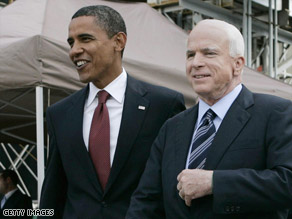
Each of the candidates for President this year are promising change. Obama has been known as a man who focuses on change since he gave the keynote address at the Democratic convention four years ago and John McCain's allure to voters on both sides of the aisle since 2000 springs from his deserved reputation as a bipartisan worker. I hope whomever wins in November stays true to his roots and he knows the way to really create change is through grace.
Our country has endured bullying as the modis operandi of politics for too long, almost a whole generation. It's time to begin collaborating again, not berating the other side into deep-held anger. The necessary first step in collaboration is to collect the consensus of the other party. Our focus should be on how we're the same and how we all can get better and not how we can win by pointing out the other side is wrong.
So that's why I was really saddened by the news this week. For all of the talk of change and maverick reformers by these two men I deeply respect, it's going to be politics as usual in the last month before the election. And that hurts even more than if it had just been another two Ivy League-educated, wealthy white men duking it out.
Wednesday, October 1, 2008
My Five Favorite Time-Travel Movies of All-Time
Travel through time is suprisingly a common plot device in movies. Army of Darkness, Star Trek IV: The Voyage Home, Terminator 2: Judgement Day, Austin Powers: The Spy Who Shagged Me and of course the Back to the Future trilogy are all movies where the plot centers around a character or characters moving through time. However in each of the cited cases, the time travel is not as important as the characters being a fish out of water. The movie is not about time travel as much as time travel is a mechanism to create the plot.
I like movies that are centered on time travel itself. The time travel needs to be integral to the plot with the additional treat of questions of causality woven into it. The central metaphor is then not a fish out of water but a fish in the current of a river. The current may normally push the fish in a specific direction. But the fish is able to swim in many directions and not just where the current takes them. Since I like these types of movies, I've seen quite a few and these are my favorite five.

Groundhog Day
Probably the most popular movie on this list, it's the one which is 100% centered on time travel and it does it in a very innovative way. The idea is causality is not being something fluid where small changes have large impacts. Instead causality is something that you repeat over and over until you get it "right", a kind of destiny forcing your hand. Free will is out the door but except in your capacity to learn.
Add on to its uniqueness that this story could only have been a movie. If you tried to tell "Groundhog Day" as a short story, it would've been almost unreadable. The consistent hiccups in the The medium of film and the audience's familiarity with film editing makes this movie not only possible but also very enjoyable.

12 Monkeys
I liked this movie because it posits that everything that will happen will happen. It's not just regardless of the involvement of time travelers either but in some cases because of those time travelers. It puts a different spin on causality than the normal "butterfly effect."
According to 12 Monkeys, you can't go back in time and kill your grandfather because you didn't already. At the same time, there are things that happened in the past that are better understood from the perspective of the time-traveler. Once you know X precedes Z but follows Y, the entire story is changed. The time travelers' role is no longer God-like with a prescient knowledge but as a cog in the machine that serves a role in advancing history to where it was going all along anyhow.

Donnie Darko
Donnie Darko is largely indecipherable on its own. Richard Kelly's strength is what is in his head, not putting what's in his head onto the movie screen. Which is why a quick plunge into the extra material on the DVD is important to understanding this movie. This is especially useful if you get your hands on the director's cut.
Once you find out about the tangent universes, artifacts and the living receiver stuff, the movie makes a great deal of sense. One of the assumptions of most time-travel movies is that there is one true time stream and we can make tangential changes in it by traveling through it to another point. This movie is different by positing that making a tangent universe is actually a bad thing.

Bill and Ted's Excellent Adventure
Okay, this movie is on here for two reasons really. First, it was a movie I watched as much as any other when I was an adolescent. My mom figured out how to use our video camera to play videotapes we rented from the videostore through the VCR and dub them. So I had a copy of this movie before owning your favorite movies was common.
Second, it's a goofy movie. It's not a heavy-handed "Going back to kill your own grandfather" time travel story. They can and do come both with and without existential dread. Bill and Ted are traveling through time to collect historical figures to come speak at the final history presentation of the school year. Even Camus would've cracked a smile at something as absurd as that.

Primer
There was a brief couple of months in early 2005 where this movie made me lose my mind. I rented it from CinemaRevolution, watched it by myself and then promptly showed it to anyone who I could get to watch it with me. It's not a movie that you can really figure out in the first time through and also gets better with repeated viewings. I was so enthralled I literally watched the movie like an addict.
It was addicting because it has the most believable mechanism for time-travel in any movie I'd seen. Normally it's a device like a flux capacitor and we're asked to suspend our disbelief that this device is the reason time travel is possible. "Primer" used a version of realistic physics to explain how time travel could actually be possible in real physics. Seeing "Primer" was, for me, like having a dream that you wake from and are convinced that it was real.
I like movies that are centered on time travel itself. The time travel needs to be integral to the plot with the additional treat of questions of causality woven into it. The central metaphor is then not a fish out of water but a fish in the current of a river. The current may normally push the fish in a specific direction. But the fish is able to swim in many directions and not just where the current takes them. Since I like these types of movies, I've seen quite a few and these are my favorite five.

Groundhog Day
Probably the most popular movie on this list, it's the one which is 100% centered on time travel and it does it in a very innovative way. The idea is causality is not being something fluid where small changes have large impacts. Instead causality is something that you repeat over and over until you get it "right", a kind of destiny forcing your hand. Free will is out the door but except in your capacity to learn.
Add on to its uniqueness that this story could only have been a movie. If you tried to tell "Groundhog Day" as a short story, it would've been almost unreadable. The consistent hiccups in the The medium of film and the audience's familiarity with film editing makes this movie not only possible but also very enjoyable.

12 Monkeys
I liked this movie because it posits that everything that will happen will happen. It's not just regardless of the involvement of time travelers either but in some cases because of those time travelers. It puts a different spin on causality than the normal "butterfly effect."
According to 12 Monkeys, you can't go back in time and kill your grandfather because you didn't already. At the same time, there are things that happened in the past that are better understood from the perspective of the time-traveler. Once you know X precedes Z but follows Y, the entire story is changed. The time travelers' role is no longer God-like with a prescient knowledge but as a cog in the machine that serves a role in advancing history to where it was going all along anyhow.

Donnie Darko
Donnie Darko is largely indecipherable on its own. Richard Kelly's strength is what is in his head, not putting what's in his head onto the movie screen. Which is why a quick plunge into the extra material on the DVD is important to understanding this movie. This is especially useful if you get your hands on the director's cut.
Once you find out about the tangent universes, artifacts and the living receiver stuff, the movie makes a great deal of sense. One of the assumptions of most time-travel movies is that there is one true time stream and we can make tangential changes in it by traveling through it to another point. This movie is different by positing that making a tangent universe is actually a bad thing.
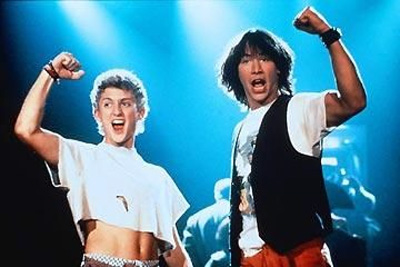
Bill and Ted's Excellent Adventure
Okay, this movie is on here for two reasons really. First, it was a movie I watched as much as any other when I was an adolescent. My mom figured out how to use our video camera to play videotapes we rented from the videostore through the VCR and dub them. So I had a copy of this movie before owning your favorite movies was common.
Second, it's a goofy movie. It's not a heavy-handed "Going back to kill your own grandfather" time travel story. They can and do come both with and without existential dread. Bill and Ted are traveling through time to collect historical figures to come speak at the final history presentation of the school year. Even Camus would've cracked a smile at something as absurd as that.

Primer
There was a brief couple of months in early 2005 where this movie made me lose my mind. I rented it from CinemaRevolution, watched it by myself and then promptly showed it to anyone who I could get to watch it with me. It's not a movie that you can really figure out in the first time through and also gets better with repeated viewings. I was so enthralled I literally watched the movie like an addict.
It was addicting because it has the most believable mechanism for time-travel in any movie I'd seen. Normally it's a device like a flux capacitor and we're asked to suspend our disbelief that this device is the reason time travel is possible. "Primer" used a version of realistic physics to explain how time travel could actually be possible in real physics. Seeing "Primer" was, for me, like having a dream that you wake from and are convinced that it was real.

Subscribe to:
Posts (Atom)